At High Hill's painted church, wooden columns take on the look of marble
The Texas church's interior rewards a closer look at the craft behind its color, from marbled wood to repeated painted patterns.
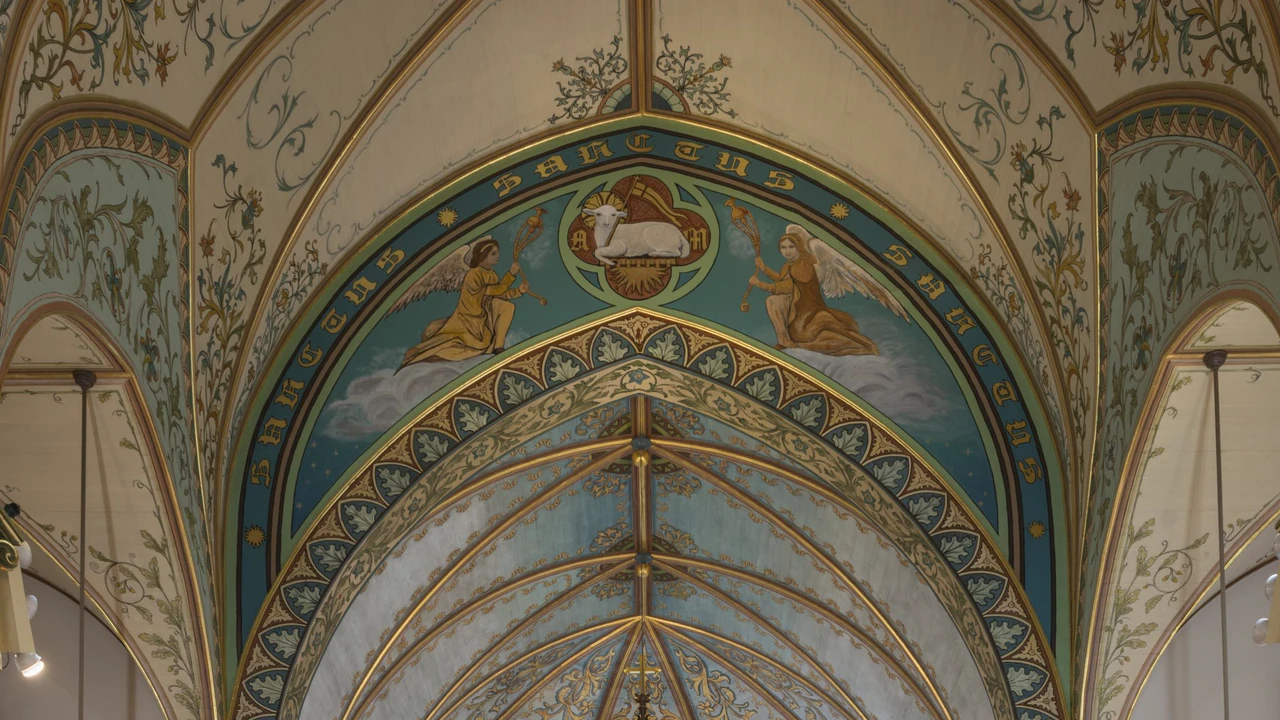
The columns inside St. Mary's Church at High Hill have the appearance of marble, but the material beneath the painted finish is wood. The National Register nomination for Texas churches with decorative interior painting identifies those columns as an accomplished example of marbling. Their color and veining are part of a painter's work, as much as the patterns overhead.[1]
High Hill, near Schulenburg in Fayette County, is home to the Nativity of Mary, Blessed Virgin Catholic Church, commonly called St. Mary's. Architect Leo M. J. Dielmann designed the red-brick Gothic Revival building, constructed in 1906. Ferdinand Stockert and Hermann Kern painted its interior in 1912. The building and its decorative work therefore belong to related but distinct stages of the church's making.
The nomination describes octagonal columns between the central worship space and the side aisles, painted in burnished ochre with red and black highlights above gray-green bases. Their capitals carry metallic-gold accents. Elsewhere, flowering vines and geometric borders extend the decoration across the walls and ceiling. These are documented features of the historic interior, rather than a report of a recent service or visit.
Marbling offered craftspeople a way to give an available material the appearance of a costlier one. Susan Kaderka's explanation of decorative techniques for Austin PBS describes the work as a hand-painted simulation of marble, often used on church columns. The related technique of graining could make pine or cedar resemble finer woods such as mahogany or rosewood.[2]
Once that distinction is visible, other parts of a painted interior become easier to read. A repeating border may have begun with a stencil: a cut pattern held against the surface while paint was applied. Several templates could build up a multicolored design. The repeating shapes still depended on someone placing the template and applying the color.
Larger patterns could be handled differently. In infill painting, the artist transferred an outline and then filled it by hand, allowing more shading than a simple stenciled shape. Freehand work dispensed with the template for an individual design or image. At High Hill, the nomination specifically identifies a combination of freehand painting and stenciling on the ceilings and walls.[1][2]
These techniques connect the church to a broader Texas craft tradition without making every painted church the same. The 1983 thematic nomination covered 15 buildings, most in German and Czech communities in Central Texas. It described religious imagery alongside decoration valued for its patterns, materials and architectural effects. The group was a documented selection, not a claim that Texas contained only 15 painted churches.
High Hill also carries materials from earlier stages of the congregation's history. According to the nomination, the 1906 church was the third building on the original church property. Eighteen stained-glass windows bought between 1884 and 1889 were reused in it. Those windows brought part of the previous building into the new one.
A Library of Congress photograph by Carol M. Highsmith, dated February 22, 2014, shows painted vines and gold-edged arches above the sanctuary, with marbled columns to either side. The catalog identifies the same painters and dates. Wood, glass and painted ornament share the interior, but each arrived there through a different kind of work.[3]
Sources
- Texas Historical CommissionDocuments decorative-painting techniques and High Hill's construction, artists, wooden columns and reused stained-glass windows.
- Austin PBSExplains marbling, graining, stenciling, infill and freehand painting with examples from Texas churches.
- Library of CongressCatalogs the February 22, 2014 interior photograph and identifies the church's architect, painters and building dates.