A frozen Thanksgiving turkey needs a thawing plan before cooking day
The refrigerator is the simplest option, but a large bird needs days. Cold-water thawing is faster and requires regular attention.
Before making room in the oven for a Thanksgiving turkey, make room in the refrigerator. A frozen bird can need several days to thaw safely. Moving it from the freezer on cooking morning is not a plan that works for every size or method.
The U.S. Department of Agriculture recommends allowing approximately 24 hours for each 4 to 5 pounds in a refrigerator set at 40 degrees Fahrenheit or below. Its whole-turkey chart gives 3 to 4 days for a 12- to 16-pound bird, 4 to 5 days for 16 to 20 pounds, and 5 to 6 days for 20 to 24 pounds. Those are planning ranges, not a reason to leave poultry at room temperature to hurry it along. [1]
Check the package weight before choosing a start day. Then work backward from when cooking will begin, leaving space for the bird and a container that can catch its juices. USDA says a turkey thawed in the refrigerator can stay there for another 1 or 2 days before cooking. That limited cushion is useful; it is not permission for an indefinite refrigerator stay.
Texas A&M AgriLife Extension's guidance recommends refrigerator thawing and placing the turkey in a dish on the lowest shelf to protect other food from drips. The advice matters in a crowded holiday refrigerator, where ready-to-eat dishes may otherwise sit below raw poultry. Move the other food before the thaw starts, rather than trying to contain a leak afterward. [2]
A still-frozen center does not prove that a bird left on the counter is safe. USDA explains that the outside can reach temperatures where bacteria multiply rapidly while the middle remains frozen. Its safe-thawing guidance also rules out storing the turkey on a porch, in a car trunk or in other places where temperature cannot be constantly monitored. [1]
Cold-water thawing offers a faster option, but it creates a job someone must keep doing. Put the turkey in a leak-proof plastic bag, submerge it in cold tap water and change the water every 30 minutes until it thaws. USDA estimates about 30 minutes per pound. Its chart gives 6 to 8 hours for a 12- to 16-pound bird. Cook it immediately after thawing; the refrigerator method's extra holding time does not apply.
Microwave thawing also requires immediate cooking. Follow the appliance manufacturer's directions rather than applying the cold-water timetable. USDA warns that some portions can warm and begin cooking during microwaving, making a later pause unsuitable. Choose the thawing method with the cooking schedule in mind, not just the time needed to soften the bird.
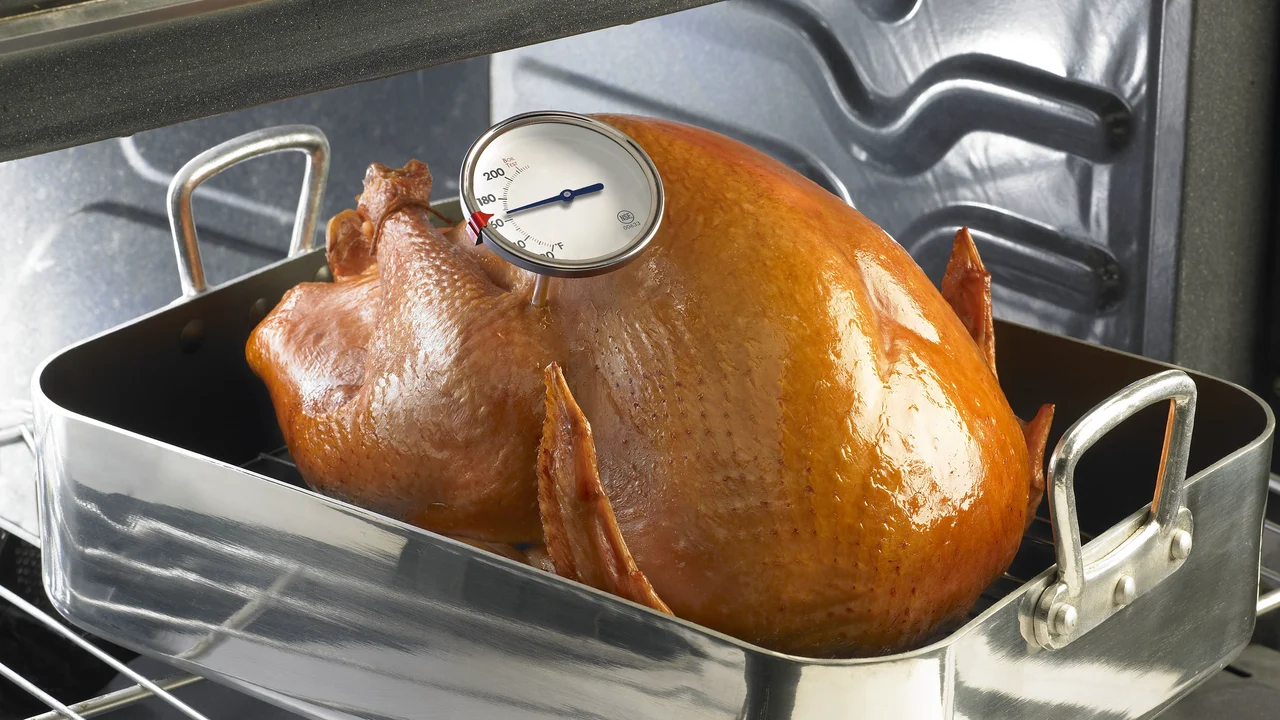
Thawing is preparation for the temperature check that follows. AgriLife says to use a food thermometer rather than judge doneness by color. Check the thickest part of the breast, the innermost thigh and the innermost wing; the turkey must reach at least 165 degrees Fahrenheit. Stuffing cooked inside the bird must reach that temperature too. [2]
The first useful holiday-kitchen decision can be made before a recipe is opened: read the weight, choose a safe thawing method and reserve the space and time it needs. If using cold water, reserve someone's attention as well.
Sources
- USDA Food Safety and Inspection ServiceSafe thawing methods, weight-based timing and when to cook after thawing.
- Texas A&M AgriLife Extension Service / AgriLife TodayRefrigerator placement, contamination prevention and thermometer checks.